
Standwise, Technology, 2026
Daily standups cut from 25 minutes to 9, with every update traced.
A software services company with hybrid teams tracked attendance in a shared spreadsheet, approved time off by email and ran daily standups that routinely overran. Today check-in, time off, standups and delivery reporting run through Standwise in the company’s existing chat and project tools, with managers approving every consequential action.
Results
Context
The client delivers software projects for its own customers, with hybrid teams working across several offices and from home. Engineering teams planned work in Jira and delivery teams used ClickUp. Attendance lived in a shared spreadsheet maintained by people operations, and time off was requested and approved by email. No single view showed who was in the office, who was remote or which projects were at risk.
Each of the 14 project teams held a daily standup scheduled for 15 minutes that averaged 25 minutes in practice. Project managers spent about four hours a week compiling status from tickets, chat threads and spreadsheets into a weekly delivery report. Time off requests waited an average of 2.5 working days for approval, and absences often surfaced only when a meeting started. Risks such as review bottlenecks or estimates that ran over appeared in the report a week after they began.
The constraints were set by the client’s security and people operations teams. Location data could be read only at the moment of check-in, and compensation or identity fields could never reach a language model. Tickets had to stay in Jira and ClickUp as the source of truth, with no write access granted to any automated agent. The client set out to cut status overhead, shorten approvals and give managers a current view of delivery across both project tools.
What we built
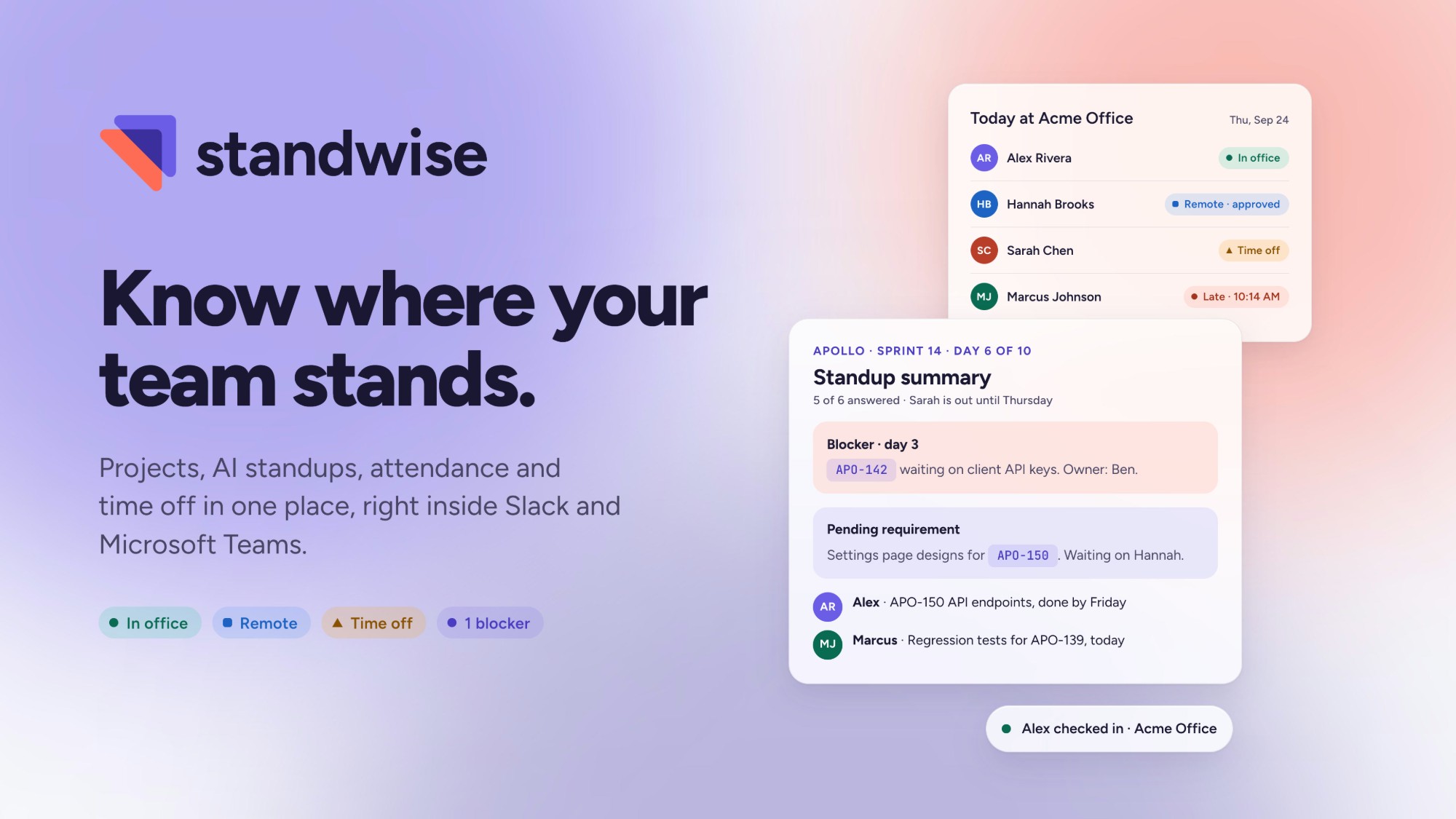
We designed and built Standwise, a multi-tenant work platform, and deployed it for the client as one of its first design-partner tenants. A shared Core holds identity, roles and permissions, the audit log, the chat hub and an integrations vault. Two modules run on it for the client. Standwise People handles geofenced check-in, a daily status for every person, time off and remote work. Standwise Projects syncs Jira and ClickUp, runs AI standups, tracks blockers and writes sprint reports.
The platform works where the client’s teams already work. People check in, apply for leave, approve requests and answer standups in Slack, and the mobile app offers a one-tap check-in when someone arrives at an office. Each check-in is verified against the office geofence and network at that moment, with no continuous tracking. Every morning one digest per office channel lists who is on leave or working remotely, never the leave type or reason.
One rule governs every agent: code decides and the language model writes. Scheduling, sprint detection, risk rules and every metric are ordinary tested code, and the model only parses replies and drafts summaries. Each number in a summary must exist in its inputs, and each item links to a ticket or the person’s own answer. Ticket write-back stayed off, as the client required, and every outside action waits in an approval queue for a named person. Every agent action is written to the audit log, and client data is never used to train a model.
How it was delivered
The engagement opened with a consultation on the client’s workflows, tools and security requirements, followed by an architecture review that fixed the design in writing. We chose a modular monolith: one TypeScript codebase with hard boundaries between Core and each module, running against one PostgreSQL cluster. Tenant isolation was built before any feature, at three layers: application filters, PostgreSQL row-level security and an isolation test suite that must pass before any merge. A named delivery lead reported to the client’s chief operating officer, acting as executive sponsor, at fortnightly steering reviews.
The build ran in milestones, each closed by exit criteria agreed before it started. Foundations took four weeks and ended with two seeded tenants proven fully isolated. Over the next twenty-four weeks we delivered the core platform, then Standwise People with Slack and the mobile app, then Standwise Projects with AI standups. Evaluation sets of over 200 anonymized standup replies and over 30 sprint datasets ran on every prompt or model change. A drop in parsing accuracy or number grounding blocked the merge.
Two issues shaped the design. Jira and ClickUp used different status models, so every external status maps onto one shared lifecycle. The model suggests each mapping and the team lead confirms it. Employee representatives raised concerns about location tracking during the consultation. We resolved them with a privacy mode that stores only an in-office or remote result, and every employee can see what the platform announces about them.
Outcome
The platform has been live with all 14 project teams since the end of the build, as part of the Standwise early access program. Over the first eight weeks of live operation, daily standups fell from an average of 25 minutes to 9 minutes. Time project managers spent compiling weekly status fell by 81%, as the delivery report is now drafted from the dashboard and reviewed before it is sent. Time off approvals moved into Slack, where managers approve with one tap.
Attendance data is now current each morning rather than reconstructed after the fact. In the same period, 92% of check-ins were completed with one tap or recorded automatically on arrival. Managers see review bottlenecks and estimate overruns across both project tools in the week they occur, rather than in the following report. The client’s people operations and engineering management teams operate the platform day to day, with ByteForge providing managed operations during early access.
A four-week observation period in live operation preceded handover. The client received operational documentation covering agent permissions, approval gates and the audit trail. The next phase in scope extends the standup agent to the client’s remaining project tools as those integrations leave early access.