
A national bank, Financial services
Every AI credit decision checked, explained and sealed as it happens.
A national bank used AI models in credit decisions and customer service, but could not show its supervisor how any single decision was made or checked. Today every AI call passes through a rules gateway we built, which enforces the bank’s policy, routes contested cases to people and seals the evidence as each decision is made.
Results
Context
The bank uses AI in credit decisions, fraud screening and customer service, through its own scoring models and models supplied by outside vendors. Its supervisor now expects banks using AI to demonstrate five things on request. The bank must know every AI system it runs and explain any individual decision. A person must be able to review a contested decision, any system must be stoppable at once and the evidence must be available to an auditor.
The bank could not demonstrate these reliably. The proof has to be collected at the moment of each decision, and no system was collecting it. Evidence for an audit was assembled by hand from application logs, model reports and email, which took internal audit about 15 working days for each request. A vendor could also change the model behind a service without notice, and nothing would detect the change.
Three constraints shaped the work. The checks could add almost no delay to a credit decision. A failure in any supporting system could never turn into an automatic approval. The record had to be one that the bank itself could not quietly alter, because its value to a supervisor depends on that. The bank set out to govern every AI decision through one control point, with evidence produced as a byproduct of normal operation.
What we built
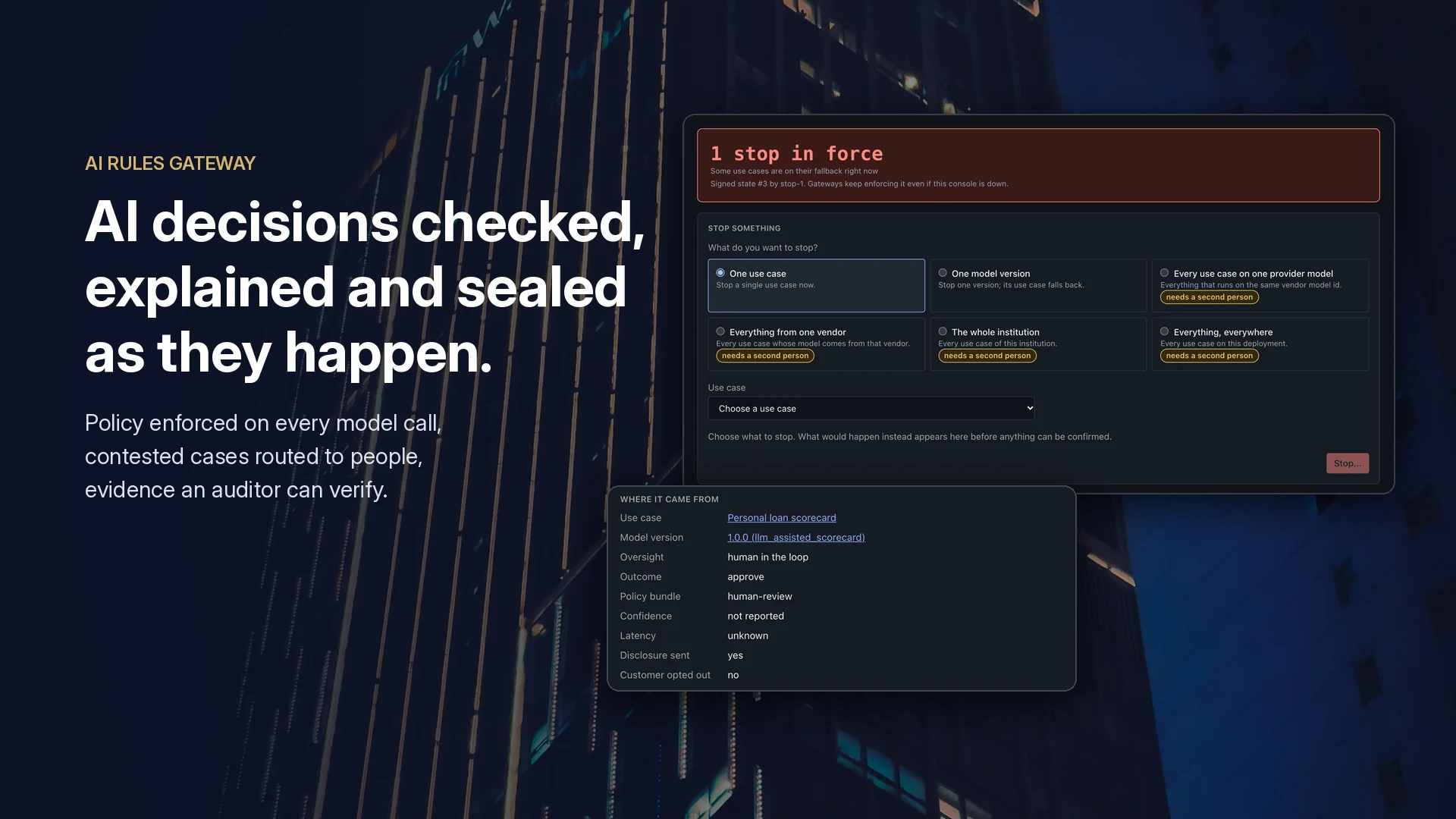
We built Mizan, a decision gateway that sits between the bank’s applications and every AI model they call. The bank’s rules run twice: before the model is called and again on its answer. The rules can allow a decision, allow it with conditions, require a person, block it or apply a fallback. Credit decisions that cannot be judged, because a dependency has failed, go to a person instead of being approved.
Each step leaves an entry in an evidence ledger. Entries are hash-chained, signed and timestamped by an outside authority, and a small standalone tool lets an auditor verify the chain without access to the bank’s systems. Any edit, deletion or reordering of an entry is detected and the exact entry is named. Personal data sits in a separate vault, so a customer’s data can be erased without breaking the record.
Around the ledger sit the controls the supervisor expects. Each declined applicant receives reason codes, the changes that would alter the outcome and a plain-language notice. Contested decisions go to a review queue, where the reviewer forms an independent view before seeing the model’s recommendation. Fairness and drift checks run on live decisions, and a kill switch can stop one use case, one vendor or all AI at once.
How it was delivered
The engagement began with a consultation and an architecture review with the bank’s model risk, compliance and internal audit teams. The review mapped each expectation in the supervisor’s guidance to a rule, a control or a record in the design. It fixed which decisions require a person, which actions the gateway may take on its own and the evidence each step must leave.
Acceptance criteria were agreed before each capability was built and run against every change. The checks include rule tests generated from each rule pack’s own cases, a tamper suite that attempts every known way of altering the record and drills that stop each dependency for real. An assurance report reads only what those runs produced and marks any missing evidence as not run, never as passed.
One decision shaped the gateway’s performance. The first latency target, 200 decisions a second within 10 milliseconds of added delay, did not hold under load through real network calls. We measured each rate, recorded the failed attempts and set the target at 50 decisions a second per gateway process, which held in every run. Capacity is added by running further processes, not by relaxing the checks.
Outcome
Every AI decision at the bank now passes through the gateway, and each leaves a verifiable record. In the first 90 days of live operation the gateway governed 1.2 million decisions. Preparing the evidence for an audit request fell from about 15 working days to one, because the audit pack is generated directly from the ledger.
The gateway adds a 99th percentile delay of 7.9 milliseconds to each decision at 50 decisions a second. In the same period the fairness checks raised one alert on a vendor scoring model, which the bank investigated through its incident process. Vendor model changes are now detected by probes, and the kill switch can stop a use case while the control plane is offline.
The bank’s model risk and credit operations teams run the gateway day to day, and internal audit draws its evidence packs from the ledger. Counts-only reports go to the supervisor, which can request further detail through an approval the bank controls. ByteForge provides managed operations and maintains the rule packs as the supervisor’s guidance evolves.