
Akhuwat Islamic Microfinance, Financial services
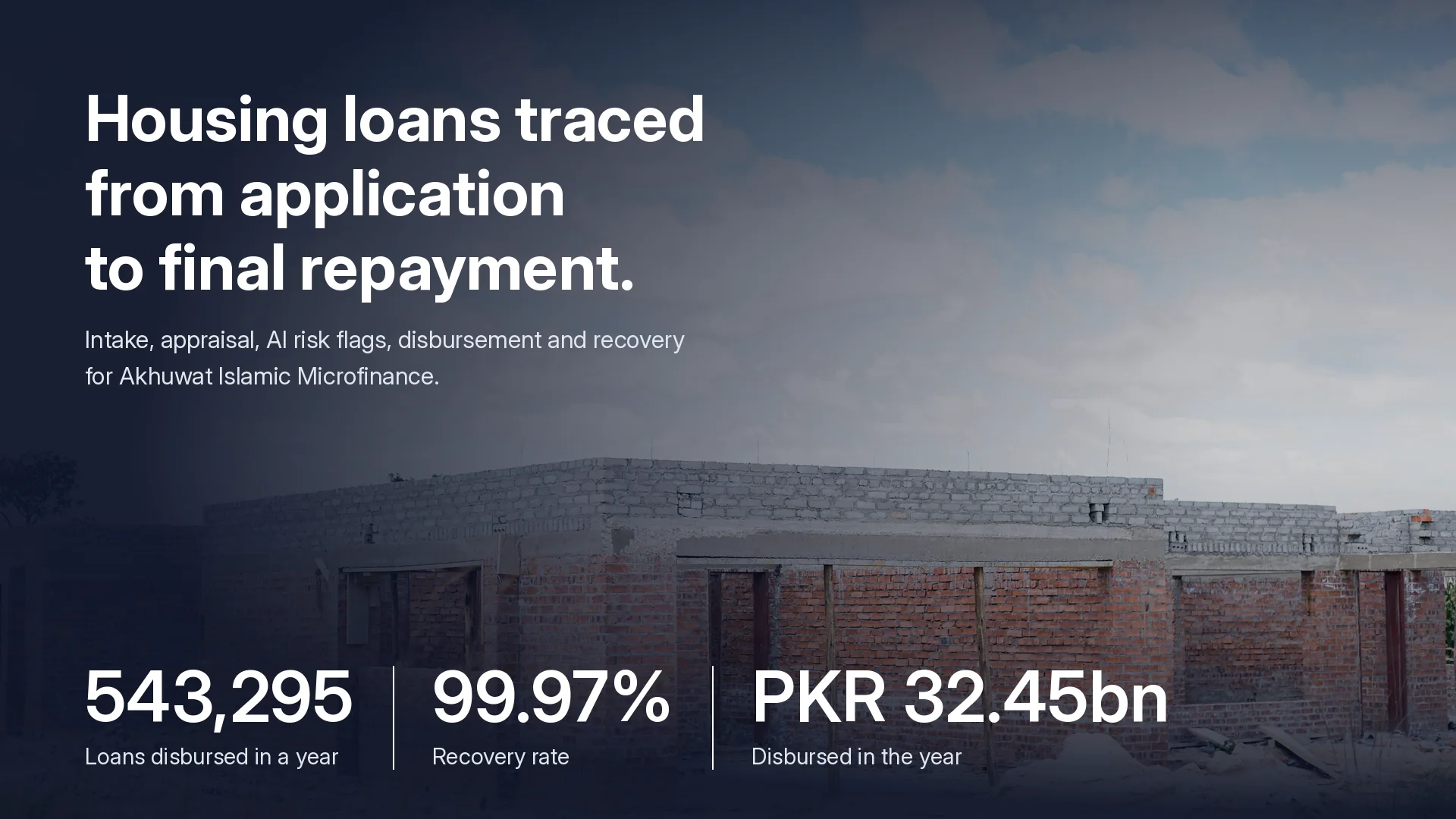
543,295 loans disbursed in a year, with 99.97% recovered.
Akhuwat Islamic Microfinance was appointed to operate the Prime Minister’s Low Cost Housing Scheme, lending to low-income households through its branch network. A platform we built now carries each loan from application through appraisal, disbursement and recovery, in a year when Akhuwat disbursed 543,295 loans and recovered 99.97%.
Results
Context
Akhuwat Islamic Microfinance lends to households that conventional banks do not serve, through a national network of branches. The government selected Akhuwat to operate the Prime Minister’s Low Cost Housing Scheme, a public program that finances the construction and improvement of homes for low-income families. The scheme began with a PKR 5 billion allocation, and government funding released to Akhuwat later reached PKR 7 billion.
Each loan of up to PKR 500,000 can fund a new house, added rooms, a kitchen or a bathroom, or a renovation. Repayment runs from 13 to 60 months, and no processing fee is charged. The applicant must own the land, hold valid ownership evidence and earn up to PKR 60,000 a month. The plot must be 5 marla or less, and widows and households earning under PKR 40,000 may receive preference.
Public funds placed three requirements on the operation. Every approval had to be traceable to the scheme’s rules and the documents behind it. Applications arrive at the branch nearest each applicant’s plot, so branches and head office had to work from the same records. Repayment also had to be tracked loan by loan, because recovered funds are lent again to the next family. Akhuwat set out to run the scheme on one system, from application through final repayment.
What we built
We built the platform that runs the scheme’s loans end to end. At intake, branch staff register each applicant with their national identity card number and record the household’s income and the intended use of the loan. They also capture the land ownership evidence the scheme accepts: registry, inteqal, fard or allotment letter. Incomplete applications cannot move forward until the missing evidence is recorded.
The application then enters an appraisal workflow. Each eligibility rule is checked and recorded: ownership, plot size, household income, age and credit history. An AI risk analysis built in Python scores every application and flags those at high risk for additional review. A flagged application proceeds only after that review, and every approval is made by Akhuwat’s staff, not by the model.
Approved loans move to disbursement with a repayment schedule of 13 to 60 months, set against the amount and purpose of the loan. The platform records every repayment against its schedule, so branch and head office teams see which loans are current and which need follow-up. Every step is recorded with the person who took it and the documents behind it. A loan can be traced from its application through appraisal and disbursement to its final repayment.
How it was delivered
We designed the platform around the scheme’s published terms and Akhuwat’s established lending practice. Each eligibility rule, document requirement and repayment term became a check or step that the system enforces. The same workflow runs in every branch, so an application is handled the same way wherever it is submitted. Changes to the scheme’s terms are applied once, centrally, and take effect across the network.
The application layer is built on the MERN stack: MongoDB, Express, React and Node.js. Branch staff work in a React interface that guides each application through intake, appraisal and disbursement. PostgreSQL holds the loan records, repayment schedules and repayments, where consistency between disbursed and recovered amounts matters most. The platform runs on Microsoft Azure.
The risk analysis was introduced to support appraisal, not to replace it. It directs the attention of appraisal staff to the applications that most need it, while straightforward applications move through the standard checks. Its output is recorded with each application, so every flag and the review that followed remain part of the loan’s history.
Outcome
In the year reported, Akhuwat disbursed 543,295 loans totaling PKR 32,449,209,000, an average of about PKR 59,700 per loan. The recovery rate was 99.97%. Each disbursement and repayment is recorded against its loan, so the portfolio can be reconciled at any time.
Under the housing scheme itself, government funding of PKR 7 billion was released to Akhuwat and disbursed to qualifying families. Government reporting recorded 7,000 homes completed under the scheme, with further homes under construction.
Akhuwat’s branch and head office teams run the platform in live operation. Every housing loan under the scheme can be traced from application to final repayment, with the documents, risk flags and approvals behind it.