
Rivet, Robotics
Robots for niche jobs, designed and proven before a part is bought.
Rivet set out to make robots economical for jobs too specialized to justify a custom machine, where design and safety work cost as much for one robot as for five hundred. We built the platform that turns a plain-language job description into a validated design, a parts list, a physics report and the software that runs the machine.
Results
Context
Small utility robots could do many jobs that are still done by hand: towing plant trays between polytunnels, patrolling a plant room, cutting verges or scouting crop rows. Few of these jobs ever get a robot. Design, validation and safety certification cost the same whether one machine is built or five hundred.
At a volume of one, that fixed cost is almost the whole price. Rivet’s analysis put a single small utility robot at between £43,000 and £153,000, of which 97% was design and certification. At 10,000 machines, the same robot costs about £1,170 and the fixed share falls to 1%.
Rivet set out to spread that fixed cost across everyone building the same kind of machine. The platform had to serve operations managers with no engineering staff. It also had to produce designs that an insurer or a buyer could sign off, which ruled out letting a language model invent a machine from text.
What we built
We built the platform as a sequence of steps, from a sentence to a running fleet. The customer describes the job in plain language, by text, voice or a site photo. A language model turns it into a structured specification and lists what it could not infer. The customer then answers three to five multiple-choice questions, and each answer changes a named engineering calculation.
The job is matched to a proven archetype, and each archetype states what it cannot do. The first is a differential-drive wheeled base for payloads of 10 to 120 kilograms, which covers tugs, carts, scouts, crawlers and mower bases. A numerical solver, not the language model, selects the motors, battery and geometry. A constraint solver chooses the parts, and a multi-objective search tunes the dimensions. It returns three real trade-offs: lowest cost, lightest and highest margin.
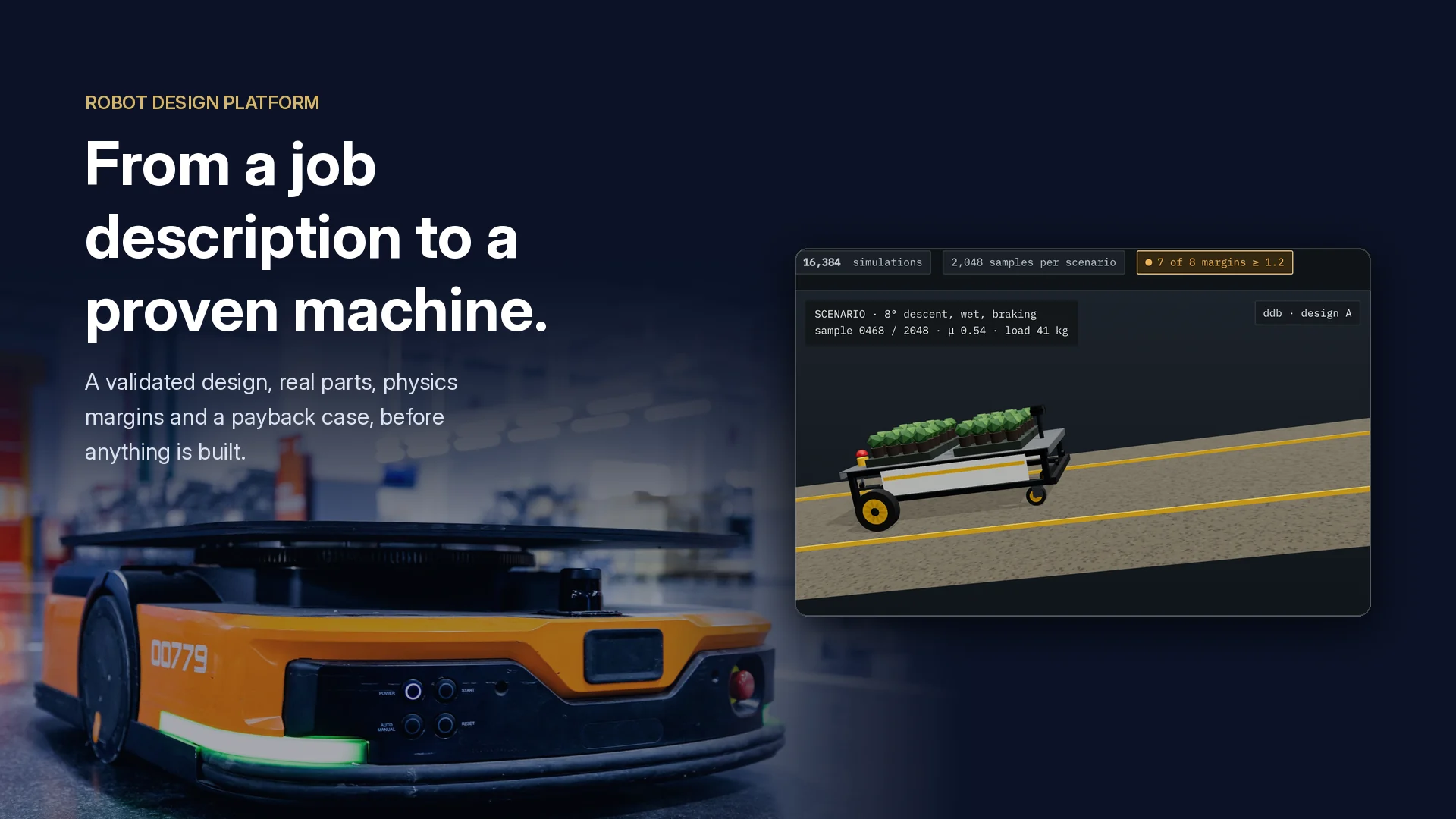
Each design is validated in thousands of physics simulations under randomized conditions. The report states the margin in the worst case for each check, with its assumptions recorded, rather than a pass or fail. The bill of materials lists only parts purchasable today, with stock and lead times, and custom metal is generated as cut files. A payback case gives the customer’s approver the number they need.
How it was delivered
The engagement began with a consultation and an architecture review with Rivet’s leadership and robotics team. The review fixed one rule above all others: the language model reads the request and explains results, but never chooses an engineering number. Motors, batteries and dimensions come only from the solver and the physics simulation.
We built an interactive prototype that runs the full sequence on a sample project in about five minutes. Each design is defined by its archetype, its parameters and a snapshot of the parts library, so the same inputs always rebuild the same machine. The 3D assembly can be inspected part by part, and bounded parameters such as wheelbase re-solve the geometry live.
Safety was kept out of learned software. The base is steered by model-predictive control, so its behavior stays explainable, and only perception is learned. Stopping and speed limits run on a separate safety supervisor. After the parts arrive, perception is trained for the customer’s site in simulation, and a signed software image is flashed to the machine. Commissioning unlocks speed and range in steps, only as each real-world check passes.
Outcome
The first pilot was a tray tug for a plant nursery, moving 45 kilograms of trays 400 meters between polytunnels and dispatch in all weather. The platform produced a 38.6 kilogram machine with a parts cost of £1,840. Its design was checked in 16,384 physics simulations before any part was ordered.
Validation flagged one real issue: on wet gravel downhill, a loaded tug could slip under braking. Swapping to knobbed tyres, at £18, cleared the traction margin. The payback case showed the machine paying for itself in under three months.
Rivet runs the platform and its first archetype, with tugs, inspection crawlers, mower bases and agricultural scouts next in scope. Machines in operation report selective telemetry, never raw video. Software improvements are tested against the fleet’s own recorded failures and released in stages with automatic rollback.