
Event parking resale automation, Ticketing, 2025
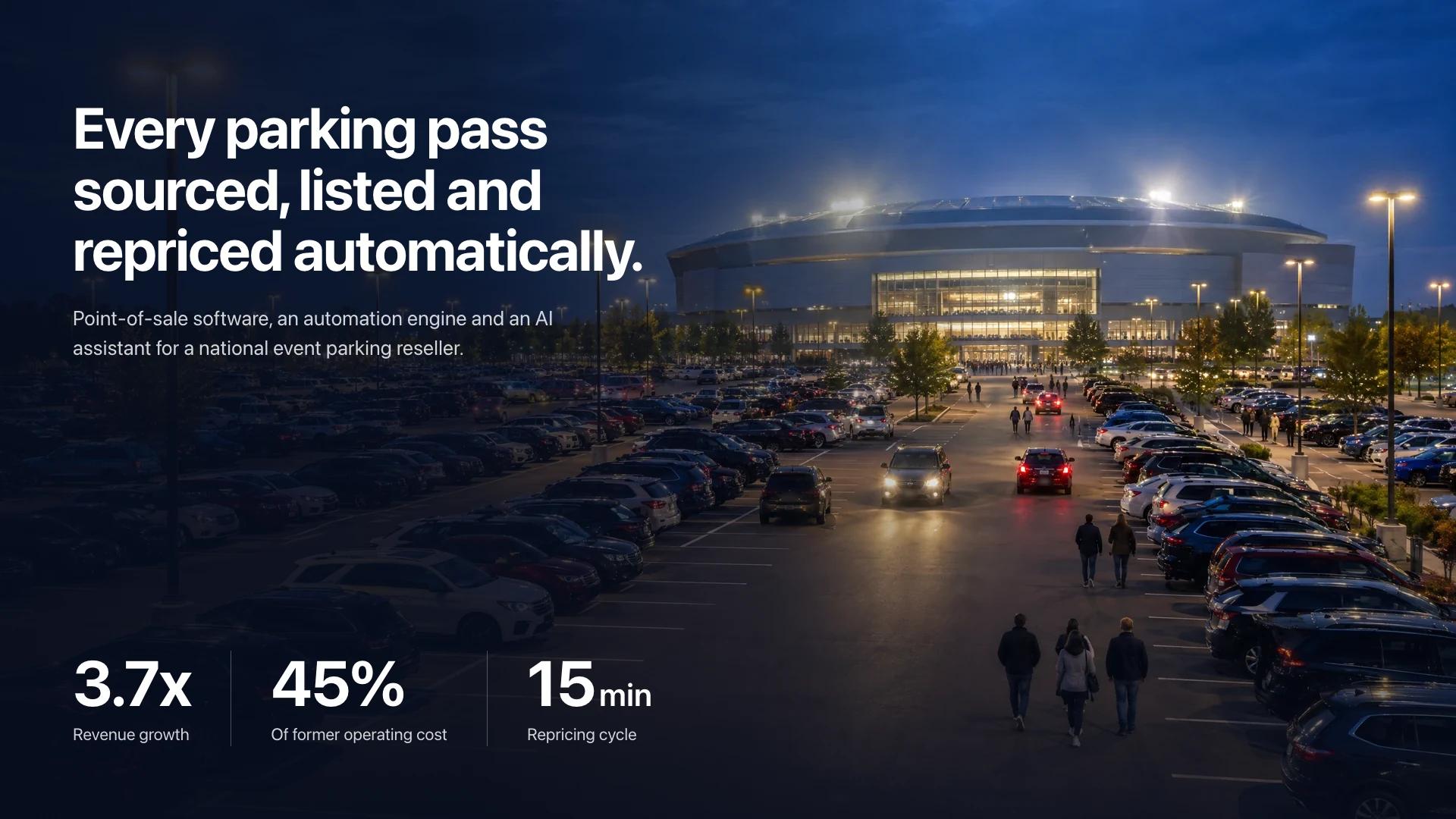
Event parking revenue up 3.7x, at 45% of the former operating cost.
A national event parking reseller ran most of its operation by hand, with a large team handling reconciliation, fulfillment and customer support. Today a platform we built and operate sources, lists and reprices its inventory automatically, while revenue has grown 3.7x and operating cost has fallen to 45% of its former level.
Results
Context
The client is a national reseller of event parking. It buys passes for lots near each venue from parking booking platforms and resells them on a large secondary ticket marketplace. It also supplies inventory to partner sellers, who export listings and report sales through an API. The marketplace catalog synced during the engagement held 165,832 parking events at 5,677 venues.
Before the engagement, most of this work ran by hand. A large operations team reconciled inventory and sales, fulfilled orders and handled customer support. Every listing had to be checked against the supplier’s current availability and cost, then priced against competing listings for the same event. Each new event and venue added to that manual workload.
Three constraints shaped the work. Supplier platforms limit request rates, so a failed read could never be allowed to look like a sold-out lot. No listing could be priced below the cost of its pass plus a configured buffer, or above a set ceiling. Listings and sales also had to stay consistent between the client’s records, the marketplace and partner sellers. The client set out to automate sourcing, listing, pricing and sales capture while cutting the cost of running the operation.
What we built
We built three systems for the client: point-of-sale and inventory software, an automation engine and a recommendation tool with an AI assistant. The point-of-sale software is where the client’s team manages events, venues, inventory, sales and users. Sales arrive from the marketplace every five minutes and are recorded once, even when the same sale is reported twice. Each sale then moves from pending purchase to pending fulfillment to complete, with the person who handled each step recorded. Partner sellers connect with API keys that are stored only as hashes and can be restricted to known network addresses.
The automation engine runs as queue-driven workers on Amazon ECS. For every upcoming event, it reads lot availability and cost from the parking platforms, keeps the cheaper source for each lot and creates or updates the matching marketplace listing. Lots no longer offered are marked out of stock, and lots costing more than $200 are held rather than listed. Each event carries only the cheapest and closest lots: 15 of each at 194 priority venues within 183 days of the event, and fewer elsewhere. Every 15 minutes by default, the pricing engine prices each listing against a comparable competing listing, plus or minus an offset, between a floor of cost plus buffer and a ceiling.
Each price records the competing listing and the rule that produced it, and every administrative change is logged with its before and after values. The engine’s marketplace actions stay off until enabled in configuration, new pricing applies only after an administrator confirms it and any sale below cost triggers an email and chat alert. The recommendation tool compares prices for the same seats on a primary ticketing marketplace and the resale marketplace, then ranks the widest price gaps. An AI assistant built on Google Gemini answers the team’s questions about the top-ranked events. It reads the results only and takes no action, so every purchase decision stays with the client’s team.
How it was delivered
The engagement began in August 2025 with the point-of-sale software and its data model. Steering reviews between the client’s team and ByteForge set priorities and tracked progress. Job processing, partner access and the first event imports followed in September, and the pricing engine entered development in October. The dashboard, sales alerts and a second parking platform integration followed in December, and the audit log arrived in February 2026.
Two decisions in 2026 shaped the system as it runs today. In June and July we replaced the third-party point-of-sale system that first supplied events with a direct integration to the marketplace’s own point-of-sale API. Listings are now created and repriced directly, and sales are read from marketplace invoices without an intermediate system. For bulk reconciliation we measured two marketplace endpoints: one returned about 5,000 listings in about 2 seconds, the other about 100 listings in about 45 seconds. We built reconciliation on the faster endpoint.
We designed failure handling so that a supplier outage never reads as an empty lot. When a parking platform fails to respond, the worker leaves the job on the queue for retry instead of marking inventory out of stock. Marketplace deletions that are not confirmed are restored and retried on the next run. Per-venue listing limits followed in August 2026, so each event carries the cheapest and closest lots instead of every lot available.
Outcome
Compared with operation before the engagement, revenue has grown 3.7x and operating cost has fallen to 45% of its former level. Sourcing, listing, repricing and sales capture now run automatically, work the operations team previously carried out by hand. Inventory is reconciled against supplier data on every run, and sales against marketplace invoices every five minutes.
On June 18, 2026, the platform held 52,886 listings across 844 events and 321 venues. The median pass cost $25.68 and listed at $33.97. Competing pricing strategies are compared on live sales: future events are split evenly across pricing groups, and each sale is attributed to the pricing in effect when it sold. The dashboard reports profit, ROI and sales velocity by event, venue, section, marketplace and pricing group.
The client’s team works in the point-of-sale software, moving each sale through purchase and fulfillment and acting on alerts. ByteForge runs the automation and pricing engines and maintains the marketplace and supplier integrations. The engagement continues under ByteForge managed operations.